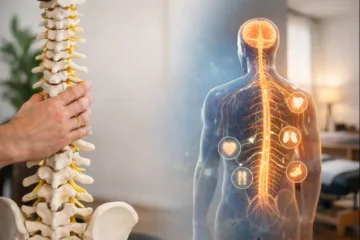
Stress and Adaptation: Why stress itself isn’t the problem, but how your body responds to it is
Stress is a term we use constantly, yet rarely define clearly. Ask ten people what stress is and you will likely get ten different answers. What stress always has in common, however, is that it places a demand on the body’s ability to adapt.
To understand stress more meaningfully, it helps to distinguish between three broad categories:
- physical stress
- emotional stress
- chemical stress
These stressors rarely act in isolation. They accumulate, interact, and are ultimately processed through one central system: the nervous system.
Three forms of stress
Physical stress
Physical stress is often associated with obvious events such as falls, accidents, or sports injuries. While these are important, they are not the most common source of ongoing stress in the body.
Far more frequently, physical stress develops through small, repetitive loads: prolonged sitting, sustained postures, repetitive movements at work or during training, and insufficient recovery. These stressors are usually pain-free at first, which is precisely why they go unnoticed while the body continues to adapt in the background. Chronic stress often expresses itself physically. One of the most common examples is neck pain that keeps returning, even without a clear injury.
Emotional stress
Emotional stress arises from both external pressures and internal processes.
External stressors may include deadlines, workload, traffic, financial concerns, or global events. Equally important are the internal narratives we carry: how we interpret situations, the expectations we place on ourselves, and whether we experience our environment as safe or threatening.
The nervous system does not respond to events themselves, but to the meaning assigned to them.
Chemical stress
Chemical stress refers to everything that enters the body.
This includes inadequate nutrient intake, lack of dietary variety, insufficient recovery support, and habitual consumption of highly processed foods, excess sugar, or alcohol. Rarely does chemical stress cause immediate symptoms. Its effects are typically cumulative and chronic, gradually influencing how well the body can regulate and recover.
Stress and the autonomic nervous system
All forms of stress converge in the autonomic nervous system, which regulates processes that occur without conscious effort: heart rate, breathing, digestion, hormone release, immune activity, and temperature regulation.
The autonomic nervous system consists of two complementary branches:
- the parasympathetic nervous system, associated with rest, recovery, and restoration
- the sympathetic nervous system, associated with action and survival
These systems function like a seesaw. As one becomes more dominant, the other is temporarily suppressed.
Survival is not the problem. Chronic survival is.
The sympathetic “fight-or-flight” response is essential. It allows the body to mobilise resources quickly in response to perceived threat. Importantly, that threat does not need to be physical.
A confrontation, ongoing work pressure, financial uncertainty, an upcoming deadline, or even a persistent thought can trigger the same physiological response. For the nervous system, the distinction between real and imagined threat is minimal.
Typical responses include:
- increased heart rate and breathing
- heightened muscle tone
- increased alertness
Less visible, but equally significant, is what becomes suppressed: digestion, tissue repair, reproductive function, and immune activity.
In the short term, this response is not harmful. The problem arises when the sympathetic system becomes chronically dominant.
Stress, adaptation, and the Neuro-Functional Shift
When stress is frequent or prolonged, the nervous system gradually recalibrates toward a heightened state of readiness. The body continues to function, but less efficiently.
We refer to this state as a Neuro-Functional Shift:
a condition in which posture, movement, and physiology are coordinated from a persistently defensive or survival-oriented baseline.
This shift does not always present as feeling “stressed”. Instead, it often shows up as:
- ongoing muscular tension
- reduced physical resilience
- neck and back complaints
- fatigue
- reduced focus or impaired recovery
The symptom is rarely the problem. It is the signal.
Adaptation is the key variable
Health is not defined by the absence of stress, but by the body’s capacity to recover and adapt.
Adaptation requires:
- adequate recovery
- variation in movement and load
- a nervous system capable of shifting fluidly between activation and rest
When parasympathetic activity is consistently suppressed, resilience erodes. Over time, the body loses flexibility, both physically and physiologically.
How we approach stress differently at UMOYA
At UMOYA Chiropractic, we do not focus solely on symptoms. We look at how the nervous system is functioning under load.
We do not use forceful manipulations or “cracking” techniques. Our approach is deliberate, controlled, and centred on:
- restoring functional movement
- supporting nervous system regulation
- improving the body’s adaptive capacity
Through a Neuro-Functional Assessment, we identify where the system is no longer adapting efficiently and why recovery has become limited.
The aim is not to eliminate stress, but to help the body respond to stress more effectively.
Awareness as the starting point
Meaningful change begins with understanding.
Recognising the sources of stress, how they interact, and how your body responds to them creates the conditions for recovery, resilience, and long-term adaptation.
Stress is unavoidable. Remaining stuck in survival mode is not.
Curious how your body is currently handling stress?
A structured assessment is often the most useful first step.
You can schedule a consultation via our booking page.