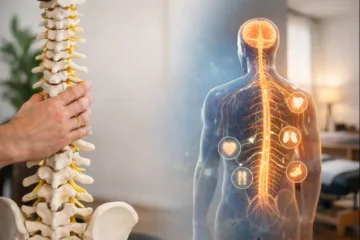
Stress, Recovery, and Back Pain: Why Your Nervous System Sets the Limits
You can train regularly.
You can stretch.
You can rest, eat well, and “do all the right things”.
And still deal with persistent back pain.
For many people, especially those juggling work, family, training, and modern life in general, back pain isn’t a sign of weakness, poor discipline, or structural failure. It’s a sign that the system running the show is overloaded.
That system is your nervous system.
Back pain is rarely just a back problem
The spine is not an isolated structure. It is part of a larger control system that coordinates movement, stability, and recovery moment to moment.
When that system is under persistent stress, the body adapts by:
- increasing muscle tone
- limiting movement options
- favouring protection over efficiency
This can feel like stiffness, recurring pain, or a body that never quite “lets go”, even when nothing dramatic is wrong on imaging or examination.
In other words, the pain is real, but the source is often upstream.
The nervous system is the control layer
Your nervous system constantly answers three questions:
- Am I safe?
- Do I have enough energy?
- Can I recover from what I’m doing?
When the answers trend toward “not really,” the body adapts accordingly.
This is not a conscious process. It happens automatically, beneath awareness, and it affects:
- posture
- muscle tone
- coordination
- pain sensitivity
- recovery capacity
If the system stays in a heightened state for too long, tension becomes the new normal. What started as a useful short-term response turns into a long-term limitation.
How stress changes posture, tension, and pain
Stress is not just psychological. It is physiological load.
Deadlines, poor sleep, emotional strain, high training volumes, illness, and under-recovery all add to the same bucket. The nervous system does not care whether the stress came from work or from the gym.
When that bucket stays full:
- muscles remain subtly contracted
- movement becomes less variable
- joints lose their natural freedom
- pain thresholds drop
The body becomes efficient at bracing, not at moving well.
Back pain often emerges here, not because something is broken, but because the system is stuck in protection mode.
Training harder doesn’t fix a regulation problem
This is where many well-intentioned people get stuck.
They feel pain or stiffness and respond by:
- training more
- stretching more
- pushing through discomfort
Sometimes that works. Often, it doesn’t.
Training adds load. Recovery removes it.
If stress is already high, adding more stimulus without improving recovery simply deepens the mismatch.
The result is a body that feels increasingly fragile despite doing “healthy” things.
At that point, the issue isn’t motivation or strength. It’s regulation.
Why back pain becomes more common after 35
For many people, these issues become noticeable in their mid-30s to 50s. Not because the body suddenly fails, but because the margin for error narrows.
Recovery takes longer.
Hormonal patterns shift.
Baseline stress is often higher.
The system can still adapt, but it needs clearer signals and better timing. What used to work automatically now requires intention.
Ignoring this reality leads to frustration. Working with it leads to resilience.
Posture reflects (nervous system) state, not discipline
Posture is often treated as something you should “correct”.
In reality, posture reflects how safe, supported, and adaptable your nervous system feels.
Telling someone to sit up straight without addressing the underlying load is like telling a tired person to “just relax”. The intent is good. The effect is minimal.
When regulation improves, posture changes naturally. Not because it was forced, but because the system allows it.
What actually helps long-term back pain recovery
Lasting change doesn’t come from chasing symptoms. It comes from improving the system’s capacity to adapt.
That means:
- understanding how stress is affecting your body
- identifying where recovery is being compromised
- restoring movement options rather than forcing patterns
- supporting the nervous system’s ability to regulate
This is why assessment matters. Guessing leads to generic advice. Measurement leads to clarity.
The real goal: adaptability, not pain avoidance
Pain is feedback, not failure.
It tells you something about load, capacity, and recovery. Listening to it early prevents bigger problems later. Ignoring it, or trying to overpower it, rarely ends well.
A resilient body isn’t one that never feels discomfort. It’s one that adapts efficiently, recovers reliably, and doesn’t get stuck in protection mode.
That is the level we aim to work at.